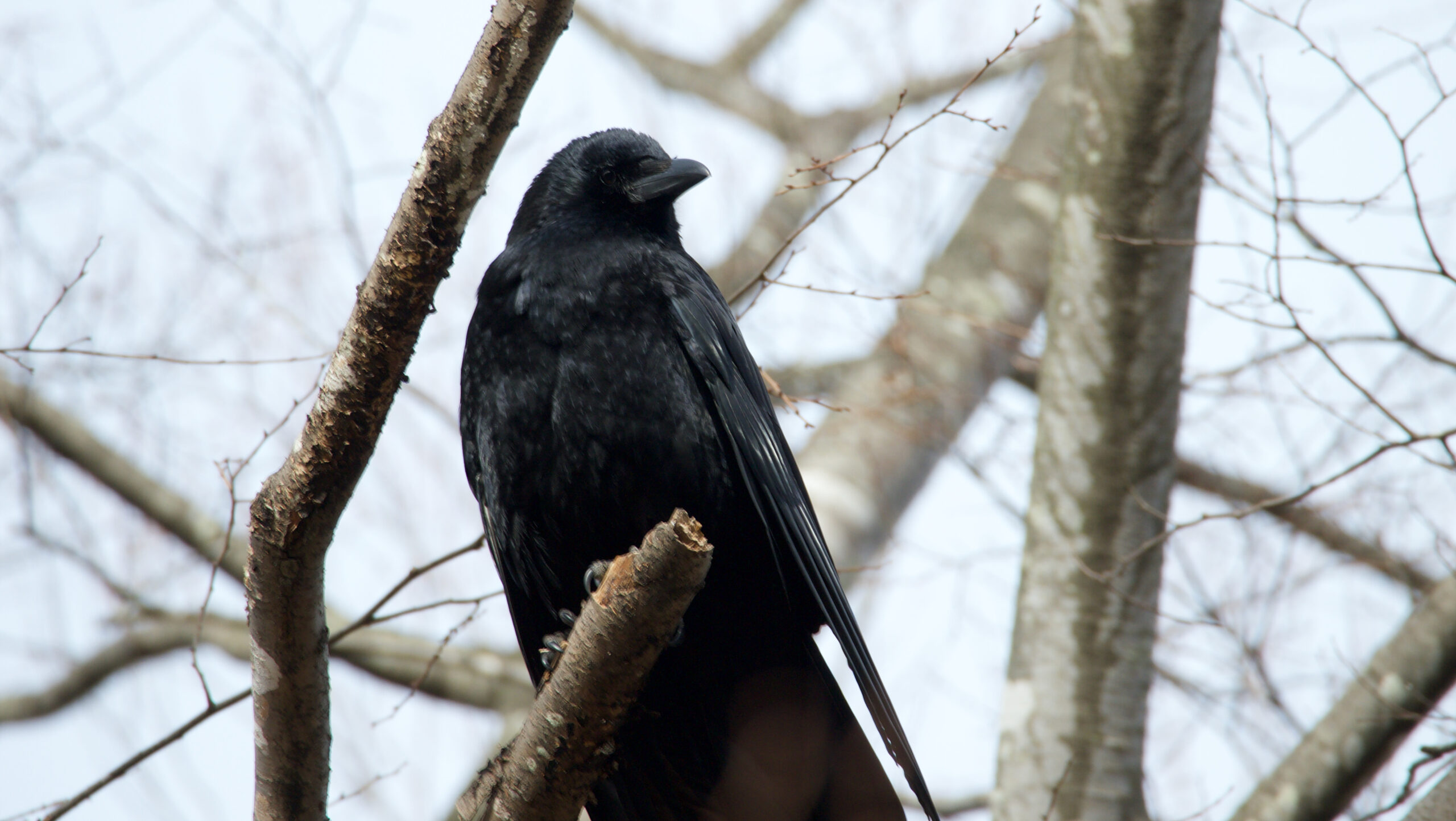
After spotting what looked like a tufted duck on the pond, I kept walking and tried photographing birds in the trees instead. Last time, the biggest problem had simply been distance. The birds on the pond were too far away. This time, though, I felt that if I could get reasonably close, even my old Olympus E-PL3 with a telephoto lens could do more than I had expected.
The photo that made me happiest was the crow facing straight toward me. Crows do not seem to panic very easily when people come near, so this time I tried moving closer as quietly as I could and taking pictures without making it nervous. The result was much larger in the frame than what I had been getting before, and it came out cleaner than I expected too. Since it was an all-black bird, I thought it might be difficult, but the eye and the shape of the beak still came through. I was honestly a little surprised that this camera could produce a shot like this. Seen from the front, the crow’s face also looked rounder than usual, and somehow much cuter.
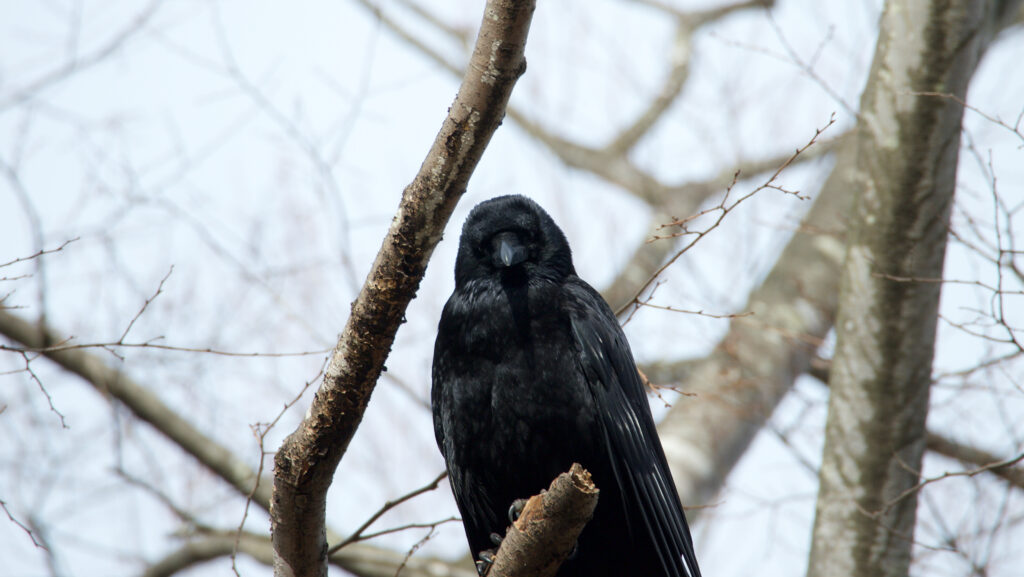
Photo: A crow perched on a tree branch in the park, facing straight toward the camera
Caption: I managed to get closer without disturbing it too much. Even with an old camera, the front-facing crow came out more clearly than I expected.
Shooting note
Olympus E-PL3 w/ Olympus M.Zuiko Digital ED 75-300mm F4.8-6.7 II
ISO 200 / 1/200 s / F7.1 / 300 mm
In this picture, even though the bird was black, the shape of the face and beak still remained visible. It was the first time I really felt, “If I can get close enough, this setup might actually do more than I thought.”
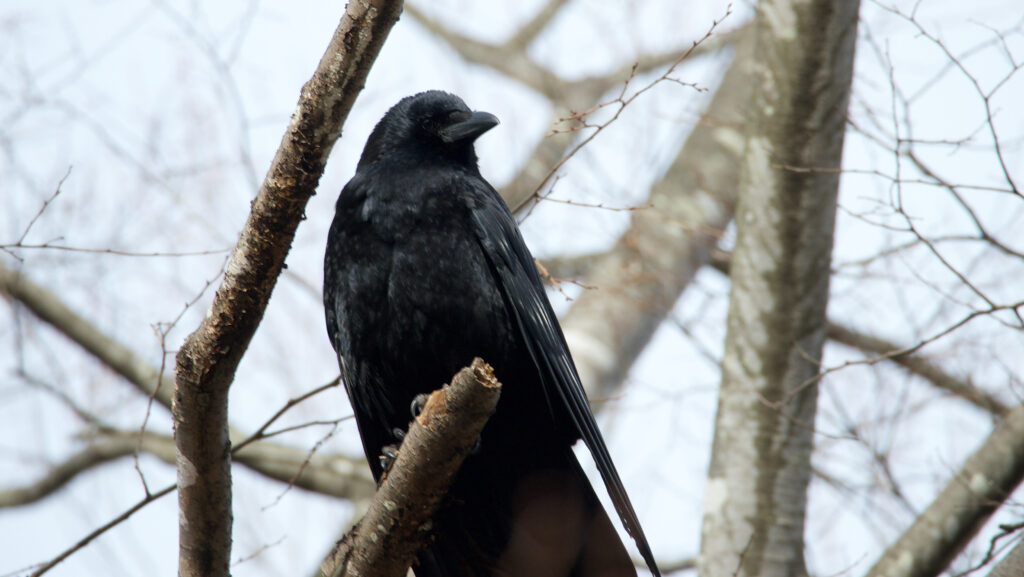
In another shot of the same crow, though, a branch ended up crossing the face. The bird itself was still facing a decent direction, but just that one branch changed the whole impression of the photo. I had seen bird photography guides mention the importance of branches, but this was the first time I really felt what that meant. Birds do not stay perfectly still, and if I move too much, they may fly off. So the decision becomes whether to shift my position a little, or just wait and hope the bird changes its angle. That part felt very much like a one-time chance. There is something in bird photography that reminds me a little of hunting, but also a little of luck, like drawing a good result from a random pull in a game. That mix of skill, timing, and chance gave it a kind of game-like fun that I had not expected.
The fluffy feathers on the top of the crow’s head also showed up in that front-facing shot, and because it seemed to be looking right at me, I think it ended up with a certain charm.
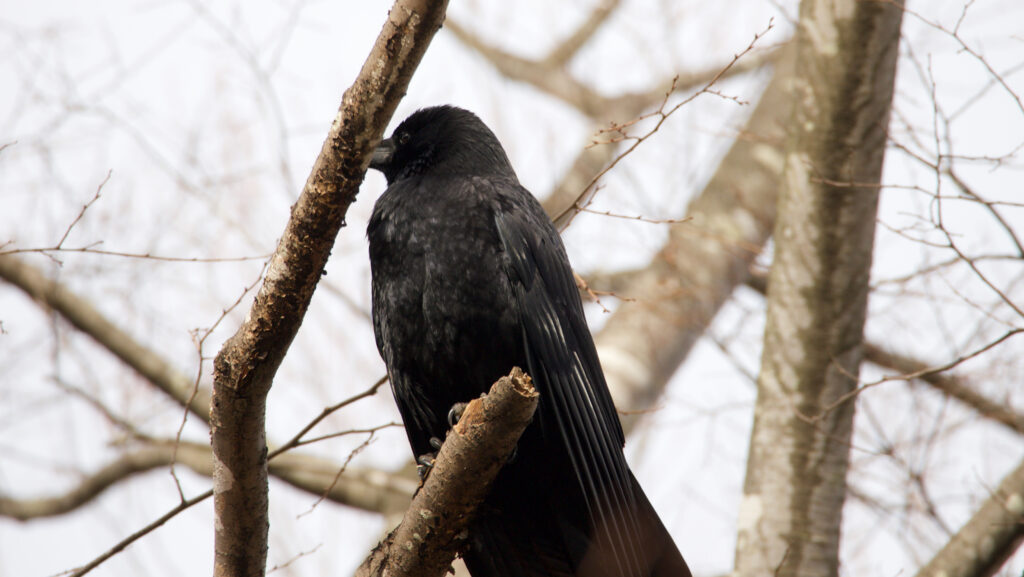
Photo: A side view of the same crow perched on a branch
Caption: Another shot of the same crow. A branch crossed the face, and it made me realize how difficult position and timing can be.
Shooting note
Olympus E-PL3 w/ Olympus M.Zuiko Digital ED 75-300mm F4.8-6.7 II
ISO 200 / 1/200 s / F7.1 / 300 mm
Compared with the first crow photo, I wanted to keep this one as a reminder of how much a single branch can turn a promising shot into an almost-good one.
After that, I managed to photograph what I think was a Japanese tit. I often hear them calling, but seeing one in a photo made me realize how round and cute they really look. For a moment I even thought it might be a long-tailed tit, but when I looked back at the picture, the face and the overall shape felt a little different. I think that kind of uncertainty, where I am not completely sure what I saw at first, is also something that becomes easier to sort out once I actually photograph the bird and look at it again later.
The first shot, though, had too many branches. A thick branch in the foreground overlapped the bird’s body, and it made me realize again how quickly small birds become difficult if they are even a little farther away than crows. They are smaller, they are often deep inside branches, and things easily get in front of the face or body. I was still happy that I managed to photograph it at all, but it also showed me that making a bird look clean in a picture takes another level of care.
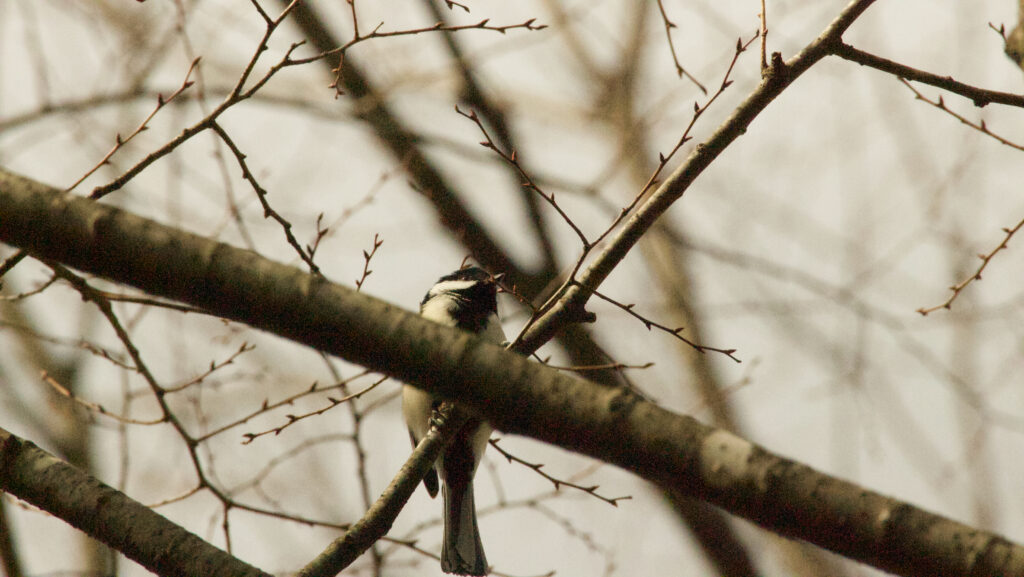
Photo: A small bird, likely a Japanese tit, perched among many branches
Caption: I noticed it from its call. The branches got in the way, but the round shape still looked charming.
Shooting note
Olympus E-PL3 w/ Olympus M.Zuiko Digital ED 75-300mm F4.8-6.7 II
ISO 4000 / 1/200 s / F7.1 / 300 mm
This picture made the difficulty very clear. With small birds in branch-heavy places, I have to think not only about the background, but also about branches in front of the bird.
In another shot, the branches were a little better arranged, and the bird’s round shape came through more clearly. I still could not get as close as I did with the crow, but I think this one kept some of the small-bird charm. What bothered me, though, was that even though it was taken at about the same time, it looked darker and rougher, with more grain. At first I wondered if it was a white balance issue, but I am not really sure yet. This is the kind of thing I still need to keep studying and improving.
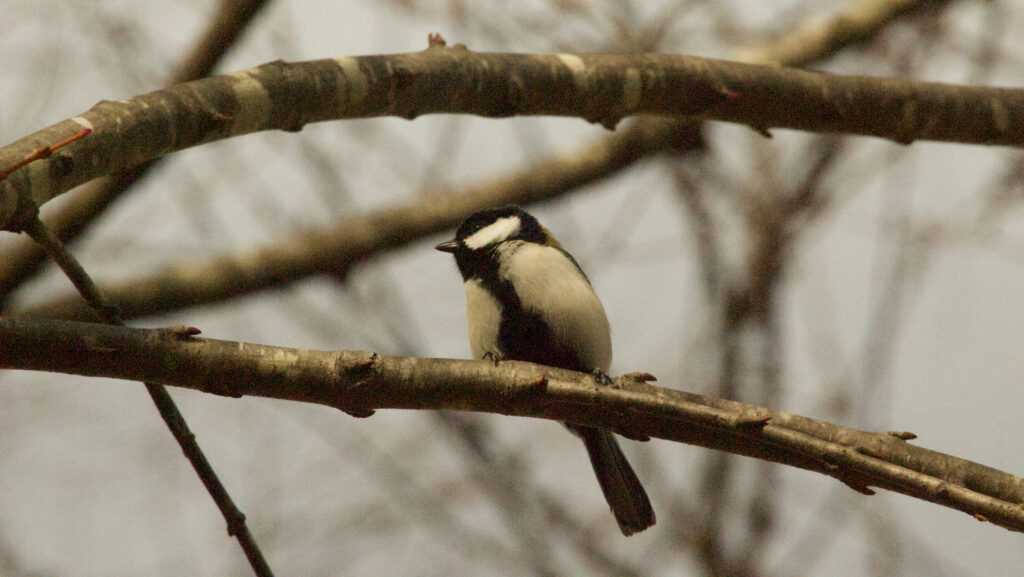
Photo: A small bird, likely a Japanese tit, perched on a branch
Caption: It was still a little farther away than the crow, but the round shape came out fairly nicely.
Shooting note
ISO 4000 / 1/200 s / F11 / 300 mm
The branch placement was better in this one, but the photo still felt a little dark and grainy.
On this walk, I felt the importance of getting close in a slightly different way than before. With water birds on the pond, the problem was physical distance. With small birds in trees, their size itself starts to feel like another kind of distance. In the end, a lot seems to depend on whether I can make the bird large enough in the frame. And once I do get a little closer, the next problem becomes branches and background placement. Little by little, I feel like I am starting to see bird photography as a series of different layers of difficulty.
Still, I am glad that this time I got at least one crow photo that felt properly successful. It also made me feel that my decision was not such a bad one after all: instead of starting immediately with an extremely expensive high-resolution camera and a huge telephoto lens, I chose to test the waters with an old camera and a more modest telephoto lens. After this walk, I feel much more positive about that choice.
Shooting summary
Camera: Olympus E-PL3
Lens: Olympus M.Zuiko Digital ED 75-300mm F4.8-6.7 II
Birds photographed: Crow, Japanese tit
Main things I noticed this time: If I can get close enough, even an old camera can do more than I expected. I also need to pay attention to overlapping branches. And even at the same time of day, photos can look quite different depending on the background and the bird itself, which is something I still want to understand better.