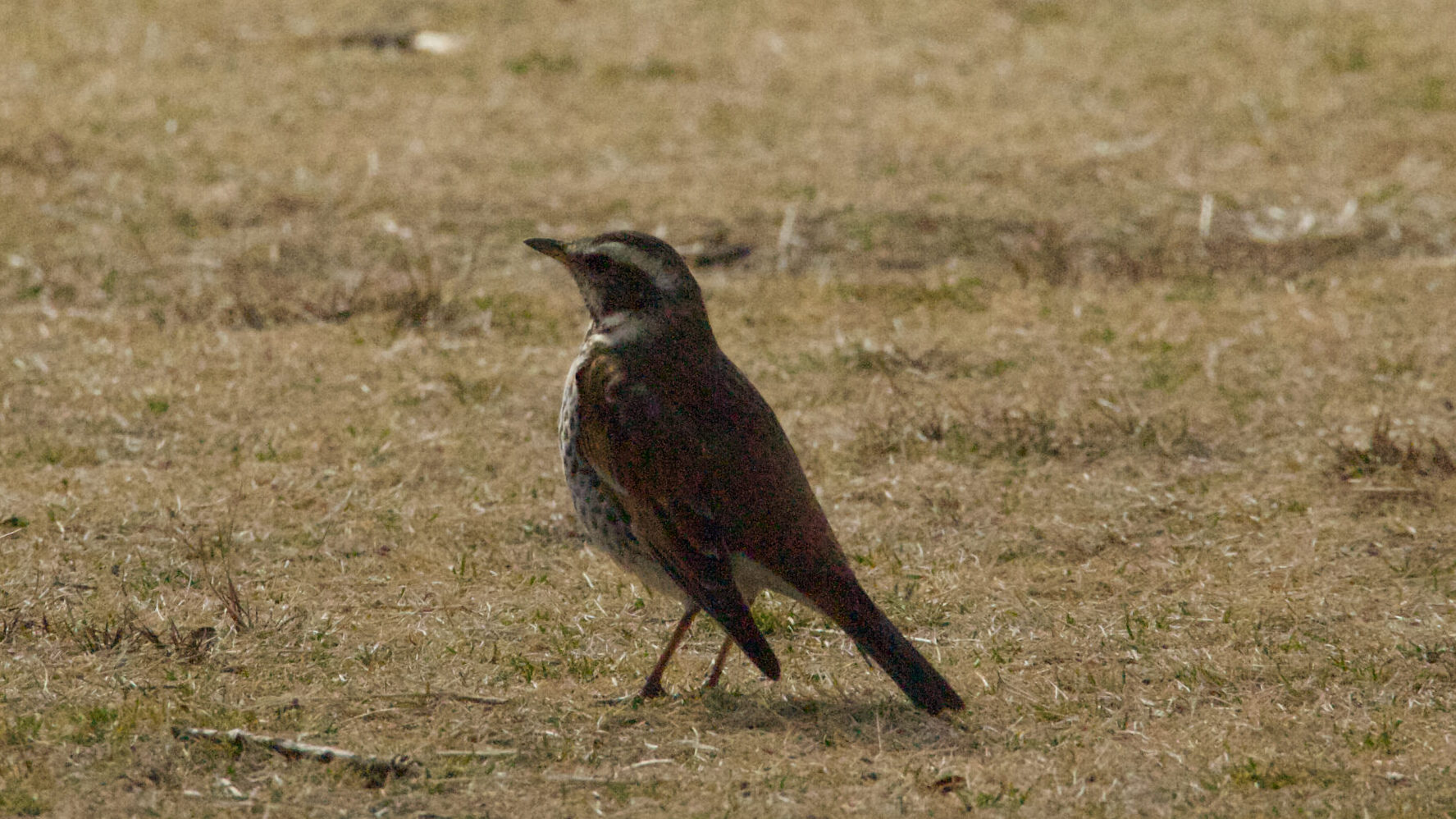
After photographing what looked like a tufted duck on the pond, I kept walking and found two more birds on the grass: a hawfinch and a dusky thrush.
This felt different from photographing birds on the pond or birds in the trees. On open ground, there is nothing between the bird and me. That also means there is nowhere for me to hide. I realized again how difficult it is to get closer to birds in an open space.
Photo: A hawfinch I happened to find on the grass
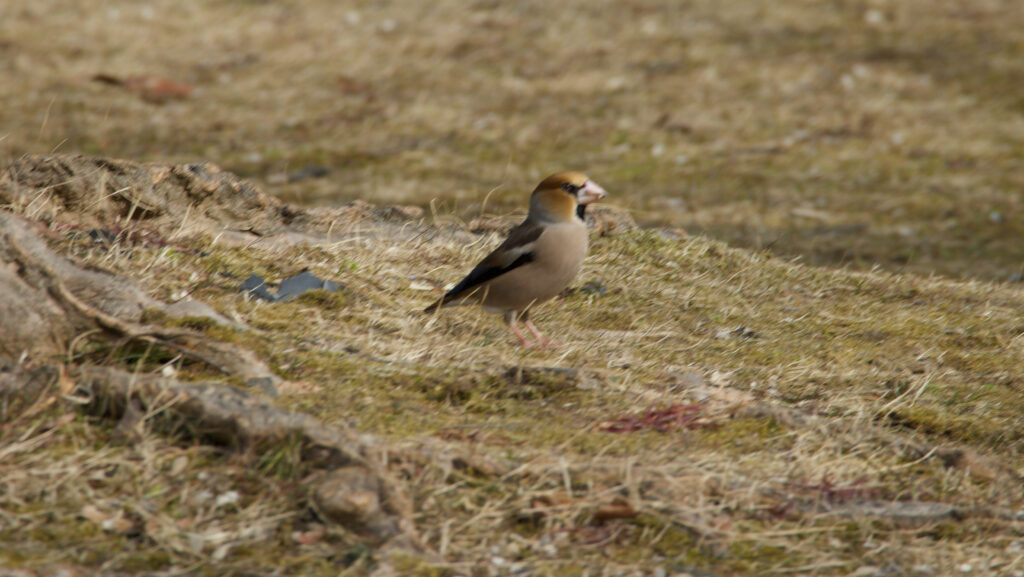
I only managed to take one photo before it flew away, but it was enough for my daughter to identify it as a hawfinch.
Shooting note
ISO 200 / 1/250 s / F8 / 300 mm
I do not often see hawfinches, and at that moment I did not even know what bird this was. It flew away almost immediately, so I only managed to take one photo. The focus is not perfect, but I still want to keep it as a record.
Even so, the thick beak and the distinctive face are just about visible. When I showed the photo to my daughter at home, she told me it was a hawfinch. She seemed a little jealous that I had seen one. That made the photo feel more meaningful to me, even though it was not a technically successful shot.
One thing I enjoy about bird photography is that I can bring the photo home and turn it into a conversation. My daughter, who already likes birds, also seemed to realize again that there are more kinds of birds around our neighborhood than we usually notice. After seeing this photo, she said she wanted me to take her with me next time.
This photo also reminded me how difficult it is to focus quickly. The bird appeared, stayed only briefly, and disappeared before I could really adjust. I may need to learn more about the autofocus settings on my camera and see if I can rely on them a little better in situations like this.
The stop-and-go movement of a dusky thrush
The other bird I found was a dusky thrush. I see them fairly often around this area, but I only started paying attention to them recently after my daughter taught me what they were.
Their movement is quite distinctive. They walk a little, stop, look for food, then raise their head and freeze for a moment. I have heard that people compare this movement to “Daruma-san ga koronda,” a Japanese children’s game similar to “Red Light, Green Light.” Once I noticed that rhythm, I started to find the bird much more interesting.
It seems that dusky thrushes are often looking for worms in the ground. Watching one move across the grass made it feel less like “just another brown bird” and more like a bird with its own habits and character.
Photo: A dusky thrush walking on the grass
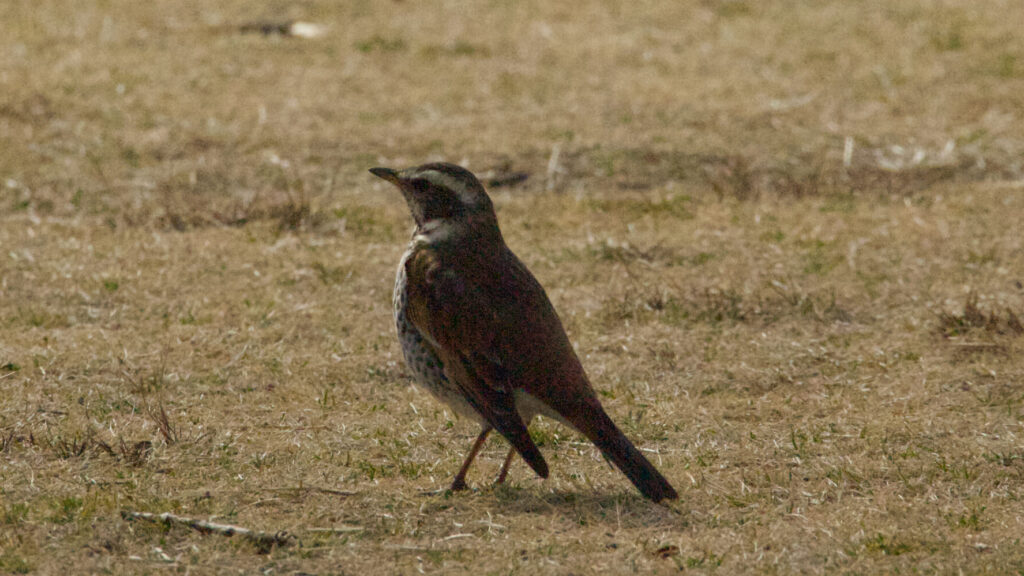
I liked the way it walked, stopped, and looked around. That stop-and-go rhythm felt very typical of a dusky thrush.
Shooting note
ISO 4000 / 1/3200 s / F13 / 300 mm
Open grass is harder than it looks
Birds on open grass are really difficult to approach. There is no tree trunk, no pond, no bush, and no branches between us. The bird can see me very clearly, and I can also see that it is watching me.
I tried to get closer little by little, but it felt like I had only two choices: move very slowly, or stop and wait. It made me wonder whether a small pop-up tent might help in a situation like this. I actually have a green pop-up tent at home, so I may try using it someday during a picnic, just to see whether the birds react differently when I am less visible.
Photo: A dusky thrush standing still on the grass
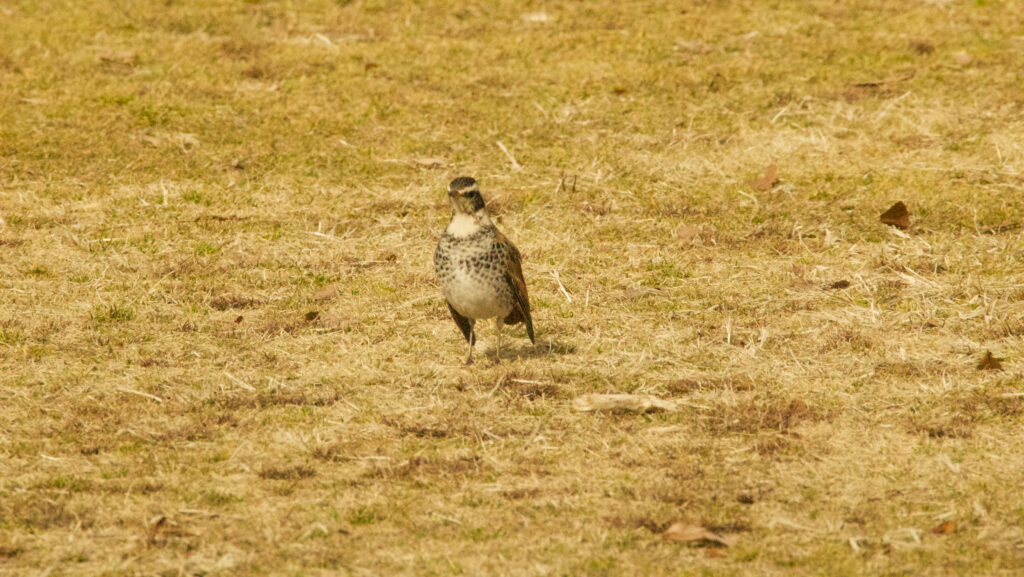
I managed to catch one of those moments when it suddenly stopped, almost like it was playing “Red Light, Green Light.”
Shooting note
ISO 4000 / 1/3200 s / F13 / 300 mm
One thing I still wonder about is the color. Just like in some previous photos, these shots came out a little yellowish. I am not sure yet whether that is because of the grass, the light, the white balance, or something else. This is another thing I want to understand better as I keep practicing.
What I learned from this walk
On this walk, I realized that distance is not the only problem. I also need to think about how visible I am to the birds.
I was wearing a fairly bright synthetic jacket that day. From a bird’s point of view, I must have looked very obvious in the open grass. In a place with nowhere to hide, my presence itself becomes part of the problem.
I am not sure if I will go as far as buying camouflage clothing, but next time I want to try a few simple things. Instead of walking straight toward the bird, I may approach at a slight angle. I may crouch down more. I may also stop more often and wait, rather than always trying to close the distance by moving.
This was not a day of perfect photos. The hawfinch was out of focus, and the thrush photos still have color and distance issues. But I learned something useful. Open spaces are not necessarily easy. In some ways, they make the bird more aware of me, and that makes the whole process more difficult.
Still, I am glad I took the photos. Without the camera, I might not have looked closely enough to notice the hawfinch at all. Even with imperfect shots, carrying a camera is slowly changing the birds I notice on ordinary walks.